Categories:
Report published by Magisterio
On May 28, CaixaForum Madrid hosted the first edition of Ed Finance & Innovation, an event promoted by Recreo Agency in collaboration with SEKLAB and ODILO. The forum brought together leading investors, startups, and education stakeholders to analyze the present and future of education, focusing on the impact of technology and funding opportunities.
The afternoon opened with an introduction by Félix López Capel, Director of SEKLAB, who presented an in-depth overview of the EdTech ecosystem in Spain. “Today, we are the third sector generating the most employment among all startups in Spain,” he emphasized, highlighting the sector’s dynamism and growth potential. López Capel also noted that Madrid and Catalonia account for 60% of educational startups, underscoring the role of regional governments as engines of innovation. “Many founders previously worked in education. They’re not here to get rich; they do it out of vocation,” he added, shedding light on the social and mission-driven nature of this emerging ecosystem.
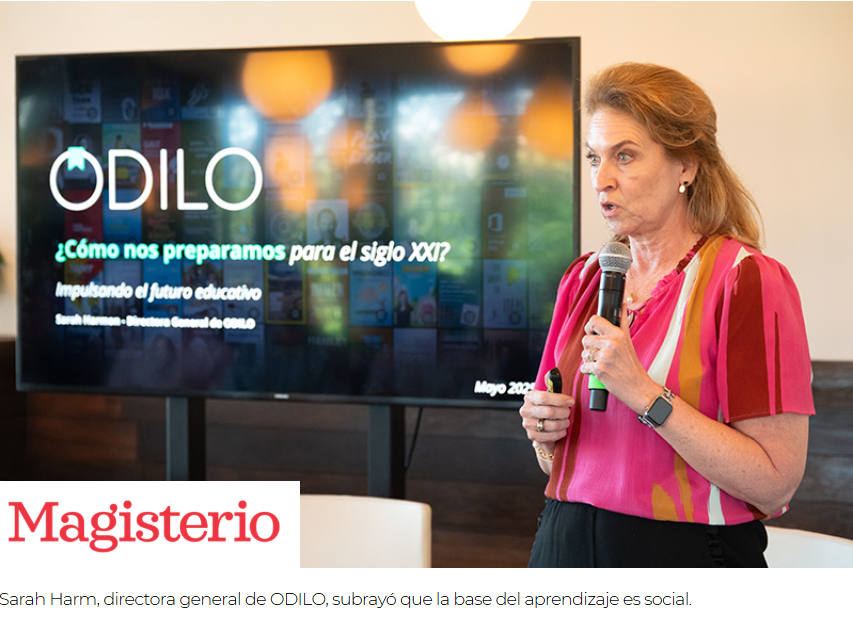
Sarah Harmon’s keynote as CEO of ODILO brought both a strategic and a human perspective to the event. “Learning is inherently social. We need to adapt our educational systems to a multimodal model and avoid relying solely on technology,” she explained. Drawing from her background in technology and HR, Harmon stressed that the key lies not only in the tools but in cultural change: “Learner engagement is what keeps me up at night. Without a culture of continuous learning, technology is meaningless.” Her words resonated strongly, especially at a time of intense debate regarding the role of technology in the classroom.
The first panel discussion, focused on Investors in Education, featured Pedro López de Guzmán (Permira), David Guerin (Brighteye Ventures), José Canales (Escuela IDEO), and Eliel Stofenmacher from Fondo Bolsa Social. Stofenmacher highlighted the importance of socially responsible investment: “Impact is a key element that must accompany profitability, especially in education,” he stated, offering a perspective that blends ethics and business.
In this panel, Guerin noted that “investing in education is investing in the future of societies,” while Canales emphasized: “Attention to diversity and inclusion is essential for social impact to be real and far-reaching.”
Montse Brau, co-founder of Clickedu, referred to the political context affecting education: “I’m seeing outrageous things, in my opinion, such as what’s happening in the Community of Madrid regarding the use of screens, which I think should be taken very seriously. I don’t believe it’s reasonable to forbid students from accessing screen-based content due to some odd line of thinking.” In a more personal tone, Brau added: “Sometimes the best things happen because you don’t realize how difficult they’ll be; you just dive in. Then there’s nothing left to say but: onward, onward, onward!”
Cristian Cisa, CEO of Dinantia, explained how his project strengthens communication between schools and families: “I enjoy helping schools when they let themselves be helped, even if it’s sometimes challenging.”
The second panel also included a remote contribution from Almería by Jorge Moreno, CEO and co-founder of Twenix, who shared his experience emphasizing the importance of continuous adaptation to user needs.
The final panel, New Players in Education, brought together Louan Rosseau (Unigow), Manuel Docavo (U4 Impact), Rafael Dorado (EONESIA), Faustino Fernández (Leeon), and Sara Martínez, CEO of Bentónico. Rosseau explained that “one in three students chooses the wrong university degree, and we want to help them with realistic guidance.” Docavo highlighted that their goal is “to channel student talent into real projects with social impact.”
Sara Martínez shared Bentónico’s perspective, an innovative startup focused on environmental and technological education, stressing the need to “incorporate sustainability and ecological awareness as pillars of future education.”
Rafael Dorado presented EONESIA as “an educational infrastructure where you can create content, publish it, and monetize it, fostering immersive learning and autonomy.”
Meanwhile, Faustino Fernández from Leeon drew attention to reading comprehension: “More than 70% of children lack the necessary reading comprehension skills to learn. Our tool gives teachers a ‘superpower’ to reverse this.” Fernández added: “The difference between having reading comprehension and not is like walking blindfolded versus riding a rocket ship.”
The event concluded with an elevator-pitch session where EONESIA, Unigow, Leeon, and U4 Impact briefly presented their projects, highlighting the most innovative aspects and the social impact of their solutions.
The day closed with a shared commitment to continue strengthening an inclusive EdTech ecosystem aligned with schools’ real needs. As Montse Brau noted: “The challenge now is to connect startup ideas with the reality of educational centers, which is extremely complex and variable.”
With its successful debut, Ed Finance & Innovation positions itself as a key event driving the future of education through innovation, investment, and collaboration.