Categories:
- Within the framework of the III Conference on Challenges of Public Administrations in Innovation and Training organized by ODILO, public representatives have discussed the need to strengthen innovation applied to public services as a lever to improve inclusion, accessibility and social cohesion, especially in educational, digital and cultural fields.
- Public Administrations from different institutions such as the Ministry of Education and Vocational Training of the Region of Murcia, the Government of Andorra (Andorra Digital) and the Department of Culture of the Generalitat de Catalunya (Library Service) participated in the event.
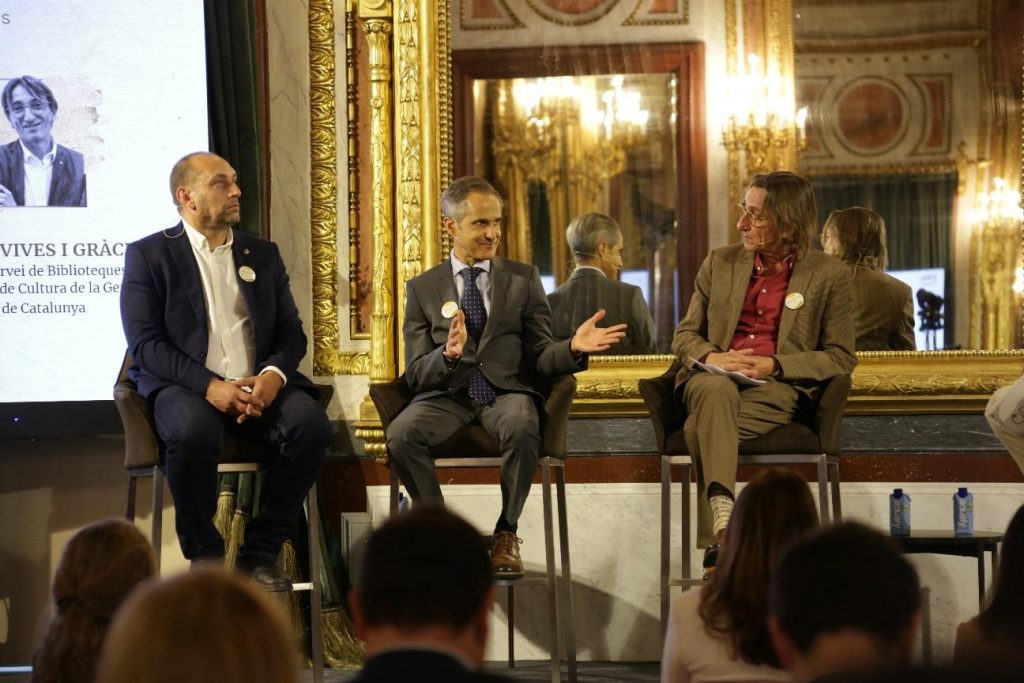
From left to right: Pedro Mondéjar Mateo, General Director of Attention to Diversity of the Ministry of Education and Vocational Training of the Region of Murcia; David Vicente Ninou, Director of Digital Andorra of the Government of Andorra; and Josep Vives i Gracia, Cap of the Library Service of the Department of Culture of the Generalitat de Catalunya.
Madrid, 21 May 2026.- Innovation applied to the social and cultural sphere is consolidated as a key tool for improving the accessibility, inclusion and efficiency of public services, in a context in which administrations work hand in hand with the private sector to reduce gaps and guarantee equitable access to resources and opportunities.
This was made clear during the round table “Maximizing the social impact of Public Administrations”, held within the framework of the III Conference on Challenges of Public Administrations in Innovation and Training, organized by ODILO in collaboration with AWS.
In the words of Sarah Harmon, CEO of ODILO: “The challenge on the table is not to digitize, but to make a real impact. Technology has never been the goal. It’s the people. Public innovation makes no sense if it does not serve to make life easier for citizens, with more accessible and personalized services.”
The debate brought together Pedro Mondéjar Mateo, General Director of Attention to Diversity of the Ministry of Education and Vocational Training of the Region of Murcia; David Vicente Ninou, Director of Digital Andorra of the Government of Andorra; and Josep Vives i Gracia, Captain of the Library Service of the Department of Culture of the Generalitat de Catalunya, who shared experiences on how digitalisation and innovation are transforming the provision of public services with a more inclusive and citizen-centred approach.
Educational inclusion and social cohesion as an axis of transformation
During the meeting, Pedro Mondéjar Mateo, General Director of Attention to Diversity of the Ministry of Education and Vocational Training of the Region of Murcia, stressed that inclusion is a structural challenge for today’s society, highlighting the need to move beyond the concept of formal equality to build true policies of social cohesion and educational integration. “For society it is a challenge to be inclusive“, he said, insisting that “it is not enough with equal opportunities, but with working on social cohesion and educational integration”.
In this sense, he highlighted the responsibility of the administrations to promote more inclusive and coordinated educational models, capable of transforming the organisation of schools towards new paradigms of attention to diversity. He also highlighted the implementation of the PlanTEA programme, an initiative aimed at guaranteeing an inclusive, equitable and quality educational response for students with autism spectrum disorder (ASD), which seeks to reduce learning barriers, improve the well-being of students and promote their participation in the educational environment.
Mondéjar also stressed that coordination between actors is key to the success of these policies, stating that “we can contribute a lot to society if we all work along the same lines”, in reference to collaboration between administrations, educational centres and families.
Technology, rights and bridging the digital divide
For his part, David Vicente Ninou, Director of Andorra Digital of the Government of Andorra, explained Andorra Digital’s approach to the development of people-centred public services, combining collaboration between administrations, the private sector and technological agents with the guarantee of fundamental rights. “We work with the Public Administration, the private sector, technological enablers, and the fundamental rights and principles of people and their competences,” he said.
In this context, he highlighted the creation of a digital wellbeing and digital skills centre aimed at guaranteeing minimum skills for all citizens, with the aim of reducing the digital divide and ensuring equitable access to digital public services. “It makes no sense to put services that cannot be used,” he said, stressing the need to accompany technological transformation with citizen training processes.
He also insisted on the importance of constant adaptation to technological change as a structural element of public innovation, pointing out that “technology is a means” and that the challenge for administrations is to “take the best of each technology” to improve the quality of public services and their impact on citizens.
Culture, universal access and digital transformation
From the cultural field, Josep Vives i Gracia, Captain of the Library Service of the Department of Culture of the Generalitat de Catalunya, highlighted the historical role of libraries as spaces for access to knowledge and social cohesion, highlighting their evolution thanks to digitization. “The library has always played an essential role. It has been much more than making resources available to citizens,” he said.
In this sense, he underlined how technology has made it possible to expand access to culture to groups that previously encountered barriers, such as people with visual disabilities, who can now continue to access reading thanks to new digital formats. He also highlighted initiatives such as Bibliodigital, a service that offers access to books, music and documentaries without ads through the library card, reinforcing the concept of universal access to culture.
An unmissable event in the calendar for the Administrations
For her part, Ainhoa Marcos, VP of Public Sector and Education at ODILO, said that “if we have learned anything in these years, it is that the great challenges we face cannot be solved in isolation. We need collaboration. We need to share knowledge. And we need to build bridges between the public and private sectors to promote projects that really generate an impact on people’s lives.”
With this purpose, the III Conference on Challenges of Public Administrations in Innovation and Training of ODILO has been consolidated as a meeting space between institutional leaders in the field of education, employment and social impact.
Representatives of different national and regional administrations have participated in this third edition, sharing experiences and lines of action around the transformation of public education, employment and social systems. At the table ‘New strategies for educational digitalisation and continuous learning’, officials from the Regional Government of Extremadura, the Government of Cantabria and the Xunta de Galicia took part, focusing on educational digitalisation and continuous learning; at the table on ‘Training and innovation to promote talent in employment’, representatives of the Community of Madrid, the Regional Government of Andalusia and the Government of the Canary Islands addressed training, professional requalification and the adaptation of talent to the new demands of the labour market; while at the table ‘Maximising the social impact of Public Administrations’, the Region of Murcia, the Government of Andorra and the Generalitat de Catalunya have shared initiatives linked to inclusion, attention to diversity and innovation in public services.
——————
ABOUT ODILO
ODILO is a digital education company that allows any organization to create its own Learning Ecosystem, offering its users unlimited access to the world’s largest catalog of multi-format educational content, and the possibility of creating all kinds of learning experiences without restrictions. More than a thousand platforms have already been created, allowing access to 170 million users on five continents.
ODILO, the largest educational ecosystem in the world, has content agreements with +7300 providers of educational digital content in all formats (courses, interactive applications, videos, podcasts, press, magazines, audiobooks, e-books, etc.)
ODILO is a multi-vertical company, which promotes learning in Private Companies, Public and Private Schools, Public and Private Universities, Certified Vocational Training, Public Administration and Government.
Press Contact
Pablo Burgos / Alfonso Garrido
pablo.burgos@evercom.es / alfonso.garrido@evercom
91 577 92 72 / 618 96 48 00
PR ODILO.
María Gracia Banderas
mbanderas@odilo.us