Categories:
- The conference organized by ODILO is consolidating itself as a key meeting point, bringing together the top education and employment officials from more than a dozen autonomous communities and governments to align future strategies.
- Vocational Training (VT) reaches 1.2 million students, backed by an investment of 7.4 billion euros, consolidating itself as a dual and flexible model that directly links classrooms with productive sectors.
- To measure real impact and adapt to the market, advanced training plans for teachers in disruptive technologies such as artificial intelligence, cybersecurity, and computing are being promoted.
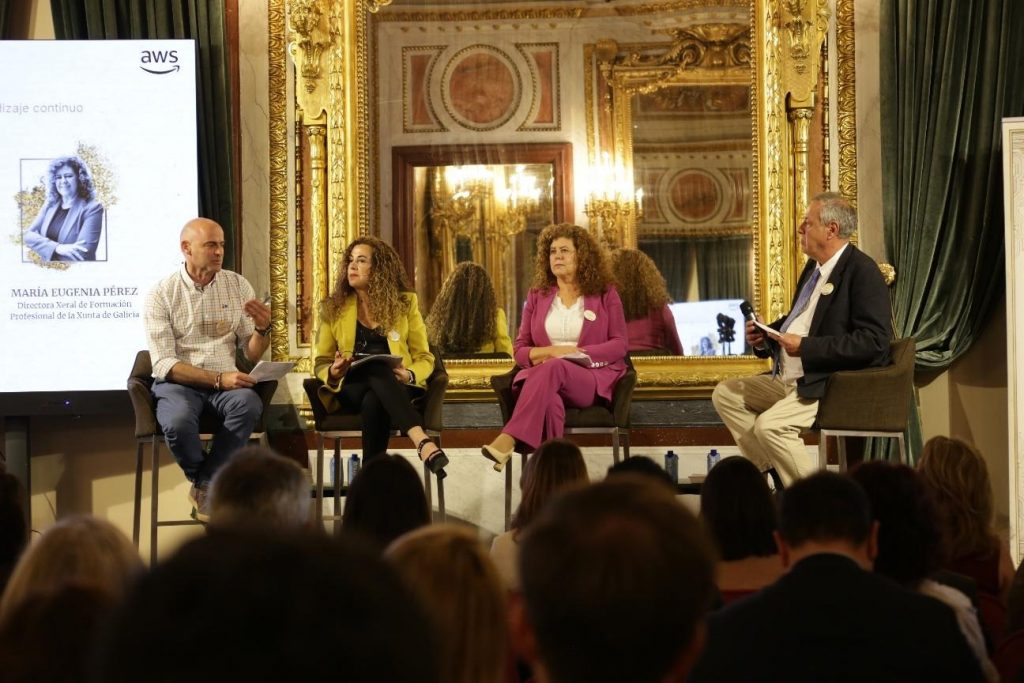
From left to right: Tomás Fernández, Head of the Information and Communication Technologies Technical Unit of the Ministry of Education, VT and Universities of the Government of Cantabria; Carmen Gómez Labrador, Director General of Educational Innovation and Inclusion of the Ministry of Education and Vocational Training of the Junta de Extremadura; María Eugenia Pérez, Director General of Vocational Training of the Xunta de Galicia
Madrid, May 21, 2026.- Educational digitalization enters a new phase. Beyond the debate on its adoption, Public Administrations are moving towards more strategic models, focused on real impact on learning, personalization of content, and the promotion of continuous lifelong learning. This was highlighted during the round table “New strategies for educational digitalization and continuous learning”, held within the framework of the 3rd Conference on the Challenges of Public Administrations in Innovation and Training, organized by ODILO in collaboration with AWS.
During the meeting, the Public Administrations agreed that the phase of mere technological adoption has currently been overcome to focus on strategic models based on real impact, equity, and lifelong learning. On this point, Sarah Harmon, General Manager of ODILO, pointed out that “AI and changes in the labor market are advancing at a breakneck pace, making continuous learning a structural necessity. We are obliged to constantly update citizens’ skills, and, furthermore, we need to define the intention in learning: what I need to learn and what the purpose is.” It is about “a training challenge that we must address as a co-creation project in which both the educational community and society participate.”
In this scenario, Vocational Training emerges as the definitive transformative axis that directly connects education with the needs of companies, backed by strong investment, highly specialized teacher training (in areas such as AI or cybersecurity) and the involvement of the entire community, including families.
In this section, Esther Monterrubio, Secretary General of VT of the Ministry of Education, Vocational Training and Sports, opened the conference highlighting “the essential role of Vocational Training in transforming the way we learn and work.” In this line, she pointed out that the Executive’s objective is to “build learning environments that maintain high standards, equity and quality, without leaving anyone behind.” Likewise, she noted that VT “is a true professional project that connects the real needs of employment with those of the productive sectors,” highlighting the progress towards “a flexible, cumulative system capable of recognizing learning acquired through different channels.”
Likewise, Monterrubio has vindicated the consolidation of dual VT, for its ability to “reach the classroom, the workshop and the laboratory, but also the company,” reinforcing the role of this study modality as a lever for training, job creation and impact on the economy: “It is real education, which reinforces the co-responsibility between the center and the company to train competent people, capable of joining real work environments and continuing to learn and adapt.”
During her intervention, Monterrubio also recalled some of the main figures that reflect the evolution of the model, with more than 1.2 million students studying VT, more than 12,000 training itineraries, more than 400 research and innovation projects developed together with companies, and an accumulated investment of 7.4 billion euros.
Digitalization as a pillar in current training
The conference also featured the participation of several regional representatives who focused on the need to assume digitalization as a training pillar, both in terms of curriculum and in the implementation of the latest innovations as part of the system.
In this section, Tomás Fernández, Head of the Information and Communication Technologies Technical Unit of the Ministry of Education, VT and Universities of the Government of Cantabria, indicated that “we have been working on digital projects since 2013 with a clear objective: that Cantabria be digital at all levels, integrating the administration of the centers, teachers, students, and families. We have devices everywhere, but there must be equity in their use and ensure that they reach homes. Engaging families in the training process is key to our strategy.”
For her part, María Eugenia Pérez, Director General of Vocational Training of the Xunta de Galicia, pointed out the importance of “having an adequate regulatory framework, aligned with digitalization and the universality of learning” that allows addressing the challenge of contemporary education, which involves “advancing in equality, innovation and equity, guaranteeing that technological transformation reaches all citizens.” To this end, Pérez highlighted that the Digital Education Law and the Lifelong Learning Law for Adults, both currently being processed, will be key to accompanying people throughout their lives and will ensure that no one is left behind.
In this context, Carmen Gómez Labrador, Director General of Educational Innovation and Inclusion of the Ministry of Education and Vocational Training of the Junta de Extremadura, recalled the importance of digital well-being, for which they have “a common framework that guarantees that we all move in the same direction” and that includes “clear guidelines on the ethical use of AI to ensure a responsible and people-centered approach.” Likewise, she stressed that “the key is to contextualize digitalization so that it is really useful and is perceived as a natural way to integrate training with innovation in educational centers.
Teacher training as one of the educational challenges
Another of the points on which the three regional representatives agreed was the importance of promoting continuous training for teaching staff with a twofold objective. On the one hand, to reinforce their role of accompanying student learning. And, more urgently, to assimilate the latest advances in technology so that they can transmit this knowledge and connect with new generations that are increasingly digital.
On this last point, Tomás Fernández pointed out that: “We have implemented specific regulations to encourage teachers to acquire and develop digital skills. A commitment that is part of a comprehensive center project, shared by the entire educational community and capable of generating real, coordinated and sustainable changes over time.
In the case of Extremadura, Carmen Gómez Labrador stressed that “we are working decisively on the continuous training of teachers, with a commitment focused on quality and on responding to the real needs of teachers. We want useful, practical and transformative training, capable of generating real and sustainable changes in the classroom”
For her part, María Eugenia Pérez, pointed out that in Galicia “we have a specific teacher training plan that includes highly specialized itineraries, oriented to the real needs of the productive and educational system. We don’t just limit ourselves to AI. We also address key areas such as cybersecurity, cybercomputing and other advanced technologies.”
An unmissable event on the calendar for Administrations
Ainhoa Marcos, VP of Public Sector and Education at ODILO, stated that “if we have learned anything in recent years, it is that the great challenges we face cannot be solved in isolation. We need collaboration. We need to share knowledge. And we need to build bridges between the public sector and the private sector to promote projects that really generate an impact on people’s lives.”
With this purpose, ODILO’s 3rd Conference on the Challenges of Public Administrations in Innovation and Training has consolidated itself as a meeting space between institutional leaders in the fields of education, employment and social impact.
Representatives from different national and regional administrations participated in this third edition, sharing experiences and lines of action regarding the transformation of public education, employment and social systems. In the panel on ‘New strategies for educational digitalization and continuous learning’, officials from the Junta de Extremadura, the Government of Cantabria and the Xunta de Galicia spoke, focusing on educational digitalization and continuous learning; in the panel on ‘Training and innovation to boost talent in employment’, representatives of the Community of Madrid, the Junta de Andalucía and the Government of the Canary Islands addressed training, professional requalification and the adaptation of talent to the new demands of the labor market; while in the panel ‘Maximizing the social impact of Public Administrations’, the Region of Murcia, the Government of Andorra and the Generalitat de Catalunya shared initiatives related to inclusion, attention to diversity and innovation in public services.
——————
ABOUT ODILO
ODILO is a digital education company that allows any organization to create its own Learning Ecosystem, offering its users unlimited access to the largest multi-format educational content catalog in the world, and the possibility of creating all kinds of learning experiences without restrictions. More than a thousand platforms have already been created, allowing access to 170 million users in five continents.
ODILO, the largest educational ecosystem in the world, has content agreements with +7300 providers of digital educational content in all formats (courses, interactive applications, videos, podcasts, press, magazines, audiobooks, e-books, etc.)
ODILO is a multi-vertical company, which promotes learning in Private Companies, Public and Private Schools, Public and Private Universities, Certified Vocational Training, Public Administration and Government.
Press contact
Pablo Burgos / Alfonso Garrido
pablo.burgos@evercom.es / alfonso.garrido@evercom
91 577 92 72 / 618 96 48 00
PR ODILO
María Gracia Banderas
mbanderas@odilo.us