Categories:
- Over 2,000 people have already accessed the Bibliodrogas Digital Library, developed and managed by the Spanish company, with 4,000 learning hours during which they have consumed more than 5,000 resources.
Published by El Español
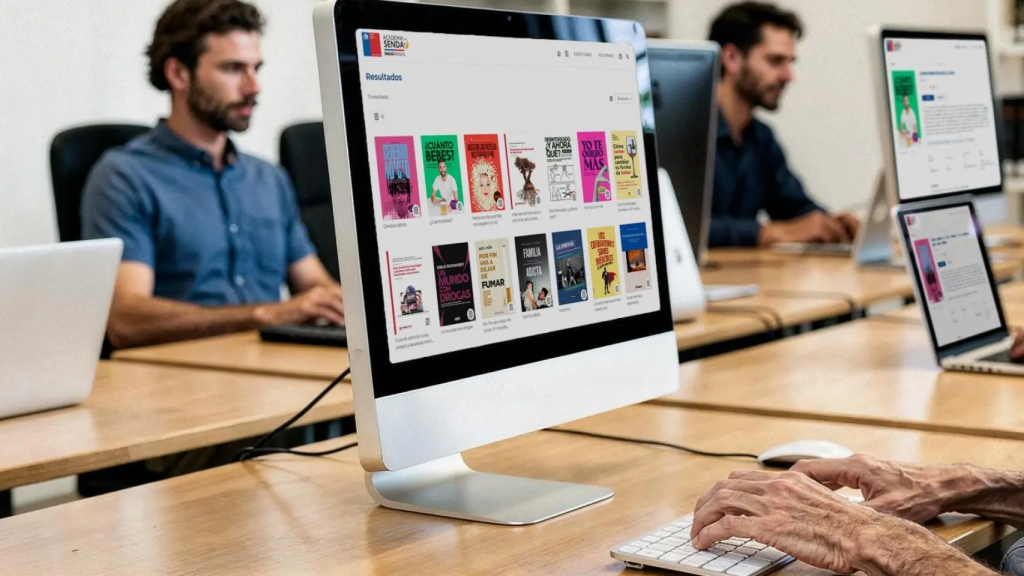
A digital library developed by the Spanish company Odilo, featuring reliable and specialized information, is one of the tools with which Chile’s National Service for the Prevention and Rehabilitation of Drug and Alcohol Consumption (SENDA Foundation) aims to prevent the use of these substances.
The project, the Bibliodrogas Digital Library, is a free-access platform developed and managed by the Spanish edtech with content on addictions and psychotherapy, stigma and health, gender and mental health, through which over 2,000 people have already been trained since its creation, accounting for 4,000 learning hours and the consumption of more than 5,000 resources.
Inclusion is one of the pillars that guided the library’s design; thus, Odilo explains, the objective was for specialized knowledge to reach any citizen simply and accessibly, regardless of their location or personal conditions.
Bibliodrogas allows users to consult content from anywhere in the country and from any device (computer, mobile phone, or tablet), thanks to native applications and offline reading functionalities. Furthermore, it incorporates accessibility modules, such as text-to-speech, which promotes inclusion. In addition, the platform integrates loan management systems, user validation, and real-time statistical reporting, which facilitate data-driven decision-making.
The project began in 2021, and, as Ainhoa Marcos, VP of Education & Public Sector at Odilo, explains, the main challenge was “to democratize access to specialized knowledge on this subject and transform it into a relevant experience for profiles as diverse as those we can find in the population of an entire country.
To achieve this, the key was combining top-quality content, learning itineraries tailored to each user, and data analytics tools to measure the real impact of the training.”
With this collaboration, Odilo strengthens its presence in Latin America, where the company has already collaborated with institutions such as the Varkey Foundation and Banco Pichincha, among others.
Latin America, a strategic market
The Spanish company’s commitment to Latin America is firm and has led it to establish a consolidated presence in countries such as Brazil, Mexico, Chile, Colombia, Ecuador, and Peru, where it collaborates with more than 290 organizations.
“Latin America has been part of our internationalization strategy since the early stages of the company’s expansion over a decade ago, identifying the region as a priority market due to its institutional dynamism and its growing commitment to digital transformation in education and training,” states Ainhoa Marcos.
The synergies with the Spanish market are also numerous, she tells us: “First, at an institutional level, there is a real desire to expand access to learning beyond large urban centers, which makes digital solutions a key lever to reach diverse populations.
Second, in the educational and university fields, we observe a strong interest in complementing traditional academic offerings with more personalized and results-oriented models. And third, in the corporate environment, companies are accelerating their reskilling and upskilling plans to respond to changing economic environments.”
For all these reasons, Odilo is committed to deepening institutional alliances, scaling proven impact models, and expanding initiatives aimed at professional requalification, especially in digital skills, employability, and lifelong learning. “We seek to consolidate Latin America as one of the company’s sustainable growth engines, actively contributing to closing educational and talent gaps in the region,” declares Ainhoa Marcos.
Ultimately, looking ahead to the coming years, Latin America represents a growth opportunity for Odilo and “an environment where impact is tangible: large-scale projects, with a focus on equitable access, talent development, and the strengthening of learning ecosystems aligned with the economic and social priorities of each country.”